Why Your Interviewer Asked You to Turn Your Head
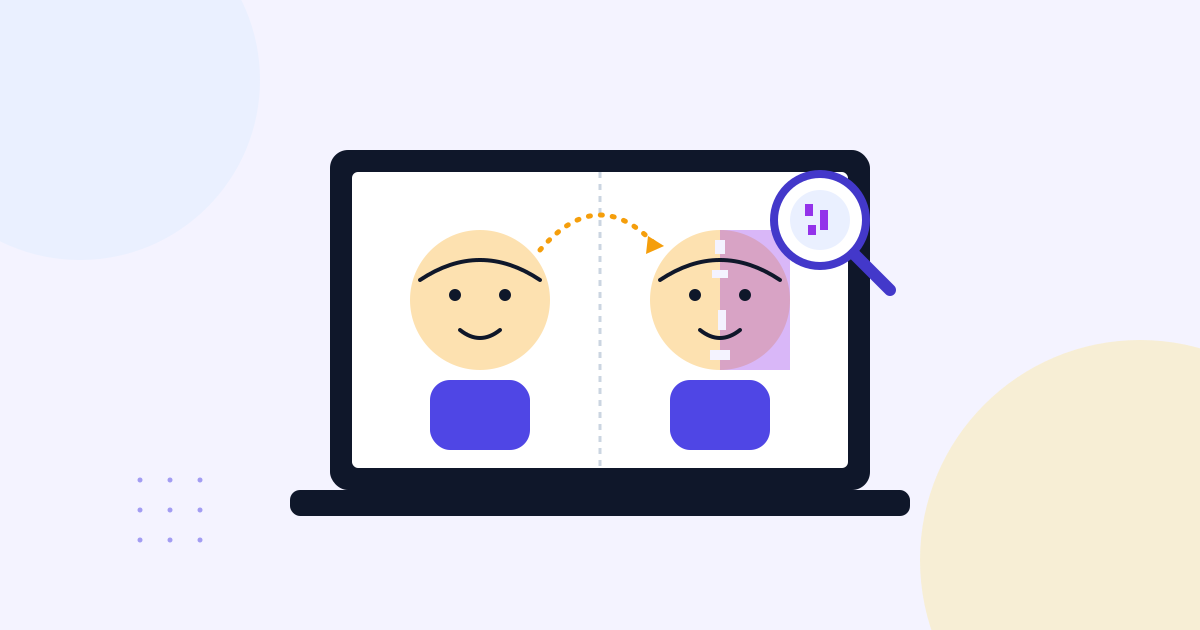
Your interviewer just asked you to turn your head side to side, or wave your hand in front of your face. It felt weird. You’re not imagining it, and no, they don’t think you’re lying about your resume — they’re checking that you’re a real, physically present human, not an AI face-swap sitting in for someone else.
Welcome to 2026’s quietly escalating hiring problem: deepfake candidates.
The interview that started it 🕵️
In February, a story out of the cybersecurity world made recruiters everywhere sit up straight. Jason Rebholz, co-founder and CEO of Evoke Security, was interviewing a candidate who went by “Kenta.” Kenta joined the Google Meet with his camera off, then finally appeared on video 30 to 45 seconds later — a small detail that, in hindsight, was the whole story.
Something felt off. “It just felt really soft,” Rebholz told IT Brew. “It felt like I was talking to a virtual person at that point.” He recorded the interview and sent it to deepfake-detection firm Moveris. Their finding: a 95% probability that face-swapping technology had been used.
A cybersecurity company — literally in the business of catching this stuff — almost hired a face that wasn’t real. If it can happen to them, it can happen to any hiring manager, which is exactly why “can you turn your head?” has quietly become a standard interview move.
Why turning your head actually works
Most real-time face-swap tools overlay a synthetic face onto a live video feed, tracking the wearer’s head in roughly one plane. Ask someone to turn 90 degrees, tilt their chin up, or wave a hand across their face, and cheap or rushed deepfake rigs tend to glitch, blur, or lag at the edges — the seams a flat overlay can’t hide. It’s a low-tech liveness check for a high-tech problem, and it costs the interviewer nothing to ask.
Translation: if you get asked to do this, it’s not personal. It’s the new version of “please hold up your ID to the camera.”
The numbers behind the panic
This isn’t a one-off scare story. It’s a trend line, and it’s steep.
The scale: Gartner projects that by 2028, one in four candidate profiles worldwide will be fake. A companion Gartner survey of 3,000 job candidates found 6% admitted to participating in interview fraud themselves — either posing as someone else, or having someone else pose as them.
The infrastructure behind it: deepfake tools didn’t get more common by accident — they got a lot better and a lot cheaper. Pindrop’s 2025 Voice Intelligence & Security Report found deepfake fraud attempts rose more than 1,300% in 2024 — jumping from an average of one per month to seven per day. Job interviews are just one more surface that trend reached.
The geopolitics: this isn’t only opportunistic scammers. In July, the U.S. State Department and FBI — joined by counterpart agencies across ten other countries — issued a joint alert warning that North Korean IT workers are using false identities, increasingly aided by real-time deepfakes and AI-polished profiles, to land remote IT jobs and funnel income back to Pyongyang’s weapons programs. Officials noted eight people had already been sentenced in 2026 for facilitating these schemes.
What recruiters are actually seeing: this has moved from theoretical to routine. A commissioned survey of 874 HR professionals and recruiters, reported by Software Finder, found 15% have personally seen face-swapping used in a video interview. And most companies aren’t well equipped to catch it — only 31% had adopted any AI or deepfake detection software, with 66% still relying on manual HR review to spot something wrong.
Zoom out: this is bigger than one weird request
Put those together and the picture is pretty clear. Deepfake tooling is getting more accessible, state actors are using it at scale, and most hiring teams are running detection on gut feeling rather than software. A “turn your head” request is a cheap, immediate patch for a problem companies don’t yet have a real fix for.
Yes, but: none of this is aimed at honest candidates. It’s aimed at the sliver of applicants running an outright impersonation scheme — someone else’s face, someone else’s credentials, sometimes someone else’s entire identity, live on the call. If you’re a real person applying for a real job with your real resume, the liveness check is a ten-second speed bump, not an accusation.
If it happens to you
Don’t take it personally, and don’t overthink it. A few practical notes:
- Keep your camera on from the start of the call — the “camera off for the first 30 seconds” pattern from the Evoke Security story is exactly the kind of thing that raises flags now.
- If asked to turn your head, tilt your chin, or wave, just do it, smoothly and without a big production. Treating it as normal is the fastest way to make it feel normal.
- Good, even lighting and a stable connection help — grainy video makes verification harder for everyone, deepfake or not.
The honest version of this moment is actually in your favor: the more hiring teams tighten up on identity fraud, the more valuable it is to walk in with a resume and interview story that’s unimpeachably yours. That’s a big part of why Bloom’s tailoring tool runs every resume bullet through a separate verification pass, checking it against your actual source resume for anything fabricated — invented tools, titles, or credentials — before you ever send it. If liveness checks are hiring’s answer to fake candidates, a resume you can actually defend, bullet by bullet, is the honest candidate’s answer to everything after the “hello.”
FAQ
Q: Why did my interviewer ask me to turn my head on a video call? A: It’s a liveness check meant to catch real-time deepfake face-swaps, not a comment on you personally. Most face-swap overlays glitch or lag when a person moves their head at an angle the software isn’t tracking well, so it’s a quick, low-cost way to confirm you’re really you.
Q: Are deepfake job candidates actually a real problem in 2026? A: Yes. Gartner projects one in four job candidate profiles will be fake by 2028, and a commissioned HR survey found 15% of recruiters have already seen face-swapping used in a video interview.
Q: Is this related to North Korean IT worker scams? A: Sometimes. A joint alert from the U.S. State Department, FBI, and agencies in ten other countries warned that North Korean IT workers are using false identities and real-time deepfakes to secure remote jobs. But most liveness checks are a general precaution, not targeted at any one applicant.
Q: What should I do if I get asked to prove I’m not a deepfake? A: Just comply calmly — turn your head, wave, whatever’s asked. It takes seconds. Refusing or getting defensive is far more likely to raise concern than the request itself.
Q: Does this mean companies don’t trust candidates anymore? A: It means companies are catching up to a new kind of fraud, not that they distrust you specifically. Most hiring teams still rely on manual review rather than dedicated detection software, according to that same Software Finder survey, so simple checks like this are filling the gap for now.
If you’re prepping for interviews the honest way, a mock run-through with structured, STAR-method questions is still the best use of your prep time — try Bloom’s interview builder or head to the app to tailor a resume you can back up, word for word, when someone asks.