Why Nobody Is Answering Your Application
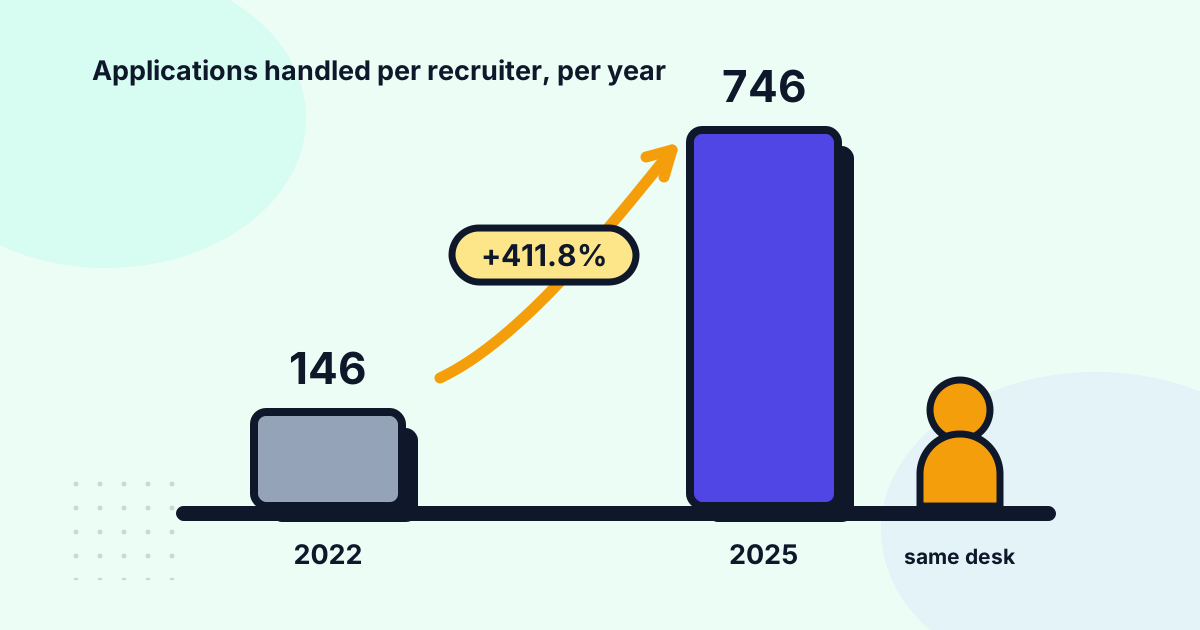
It’s a capacity problem, not a verdict. The average recruiter went from handling 146 applications a year to 746 — while recruiting team sizes were cut roughly in half.
That’s the silence. It isn’t personal, and it usually isn’t even a decision.
The 30-second version
- Applications per recruiter rose 411.8% since 2022 — from 146 to 746 a year.
- Recruiting team sizes have been cut in half over the same stretch.
- Interviews per hire barely moved: +4.5%. The funnel didn’t widen, the top of it flooded.
- So most applications aren’t rejected. They’re never individually assessed.
- The fix is fewer, better-aimed applications through better channels — not more volume.
What actually happened on the other side
Greenhouse’s March 2026 benchmark report, built on more than 640 million applications across more than 6,000 companies, lays out the squeeze:
| Metric | Change since 2022 |
|---|---|
| Annual applications per recruiter | +411.8% (146 → 746) |
| Monthly hires per recruiter | +122.3% |
| Interviews scheduled per recruiter | +128.0% |
| Average interviews per hire | +4.5% |
| Jobs closed with a hire | +7.9% |
Read that table twice. Applications per recruiter went up more than fivefold. Interviews per hire went up 4.5%.
Why it matters: the number of humans deciding didn’t change much, and the number of interview slots barely changed at all. What changed is how many applications are stacked up in front of each of those unchanged slots.
Greenhouse’s own framing is that recruiters are “making more placements, not getting buried under volume” — which is true from the employer’s side, and is precisely why it feels the way it does from yours. The system is clearing roles efficiently. It just isn’t reading everything to do it.
What this means for you, practically
Silence is not feedback. You cannot learn anything from a non-response, because in most cases nobody formed an opinion to withhold. Treat no-reply as no-signal, not as rejection.
Being seen is now the first hurdle, before being chosen. That reframes what you should optimise:
- Channel first. External job boards drive 49.9% of applications and 22.6% of hires; company career sites drive 23.8% of applications and 34.4% of hires. Same application, roughly 3× the conversion, four extra minutes.
- Referrals are the actual shortcut. They’re 11.6% of hires from a small slice of volume. One message to a human who already works there skips the entire queue problem.
- The top third of the resume. In a 244-deep pile the first eight seconds decide whether there’s a ninth. Lead with what this posting asked for.
- Apply early. Piles are triaged in order more often than anyone admits.
What not to do
- Don’t send more of the same. You’re adding to the number that caused the problem.
- Don’t read silence as a resume problem without evidence. If you’re getting no replies through boards but replies through referrals, your resume is fine and your channel is broken.
- Don’t follow up four times. Once, after 7–10 days, then move on.
- Don’t rewrite everything after every rejection. Change one variable at a time or you’ll never know what worked.
Bottom line: you’re not being ignored by 200 people. You’re queued behind 243 others in front of a recruiter carrying five times the load they carried in 2022.
FAQ
Should I follow up if I never hear back? Once, after about a week to ten days, addressed to a person if you can find one. A short note referencing the specific role. Then let it go — a second and third follow-up don’t move capacity-limited queues.
Does applying again to the same company hurt? No. Apply to a different role, or the same role in a later cycle. Recruiters churn and requisitions reopen; a “no reply” six months ago carries no memory.
Is my resume the problem or the market? Compare channels. If referrals and direct applications get replies and job-board applications don’t, it’s the channel. If nothing gets replies anywhere, then look at the resume.
Bloom keeps one master resume and builds a tailored version per posting in a couple of minutes, verifying every line against your source — so being seen doesn’t cost you an evening per application. Try it free.
Sources
- Greenhouse, The Hire Standard: benchmark report, March 2026 (North America) — applications per recruiter, hires per recruiter, interviews per hire, source mix; 640M+ applications across 6,000+ companies.
- U.S. Bureau of Labor Statistics, Job Openings and Labor Turnover Summary, July 2026 — 5.1 million monthly hires against 7.3 million openings.