Virtual Career Fair vs. In-Person: What the Attendance Data Says
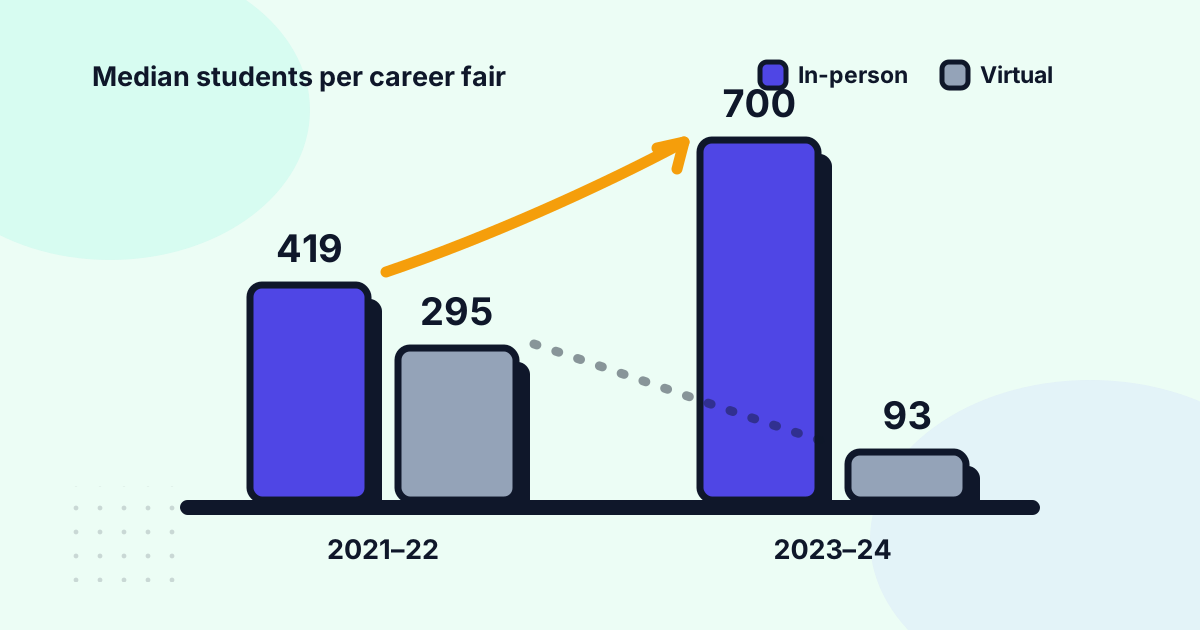
Everybody went back to the gym, and almost nobody logged on. Median attendance at in-person career fairs climbed to 700 students. The median virtual fair drew 93.
Most people read that as “virtual fairs are dead.” Wrong read. If similar employers show up to both, the fair with 93 attendees is the one where you actually get talked to.
The 30-second version
- In-person attendance surged to a median of 700 students. Virtual fell to 93.
- Employer booths barely moved — a median of 98.5 to 109 organizations — so the queue per recruiter got much longer.
- Virtual is less crowded, free to attend, and doesn’t cost you a shift at work.
- Virtual’s weakness isn’t reach. It’s memorability.
- In person for local employers. Virtual for anywhere you’d have to fly to.
What happened
The pandemic made every fair virtual. Then it un-made them.
NACE’s Career Services Benchmarks tracking shows the swing: median student attendance at in-person fairs rose from 419 in 2021–22 to 700 in 2023–24, while median virtual attendance fell from 295 to 93. Employers followed — the median number of organizations at virtual fairs dropped sharply while the in-person median ticked up from 98.5 to 109.
Why it matters: run the arithmetic nobody runs. Roughly 700 students competing for about 109 employers is ~6.4 students per booth — and half the room is queuing for the same eight famous logos.
Less competition per recruiter isn’t a consolation prize. It’s the reason to go.
The case for the gym
Memorability. Someone shakes your hand, hears your voice, watches you react. A chat window doesn’t do that, and NACE’s reporting finds employers rate in-person events as considerably more effective for recruiting.
Serendipity. You walk past a booth you’d never have clicked on. Doesn’t happen in a scheduled video slot.
The case for your laptop
Geography stops mattering. The underrated one. Ohio to Austin is a plane ticket in person and a Tuesday afternoon on Zoom.
It’s free. No parking, no travel, no lost shift. If you’re currently employed, virtual is often the only format you can attend without burning PTO.
It rewards prep. In a queue you get whatever 90 seconds you’re handed. In a booked virtual slot you know the employer in advance — so you can show up having actually read the posting.
There’s academic interest here too: a 2025 study in Applied Economics Letters, Virtual vs. in-person career fairs: the impact on search activity and diversity, used real-time search data to compare what each format does to job-search behavior and to who participates at all.
How to not waste one
Virtual fairs fail for a boring reason: people treat them like a webinar. Attendance isn’t participation.
- Book the 1:1 slots. Most platforms offer them. People who book get value; people who browse don’t.
- Read the posting first. You have the employer’s name in advance — an edge in-person never gives you.
- Send the tailored resume, not the master. It arrives as a file, which means it goes straight into the system that reads for keywords.
- Camera on, background boring, name spelled right. Low bar. Most people trip on it.
- Follow up the same day, referencing one specific thing they said.
So which one?
| Go in person if… | Go virtual if… |
|---|---|
| Your targets are local | Your targets are out of state |
| You’re better in the room than on camera | You’re employed and can’t take a day |
| You want serendipity | You know exactly which 5 employers you want |
| You’re still exploring | You’ve done the homework |
The genuinely bad option: registering, logging in, lurking in the lobby for 20 minutes, logging off. That’s what the attendance numbers are actually measuring.
FAQ
Are virtual career fairs worth it in 2026? Yes — for reach, out-of-region employers, and a far better attendee-to-recruiter ratio. Not as a substitute for your own school’s flagship fair if your targets are there.
Do I need a different resume for a virtual fair? Same resume, but tailoring per employer matters more, because yours arrives as a file that gets processed rather than a page someone skims while talking to you.
Can I attend a fair at a school I don’t attend? Sometimes. Plenty of public, industry and consortium fairs are open. Check the registration page instead of assuming.
Bloom turns one master resume into a targeted version per employer in a couple of minutes, and checks every line against your source resume — so what you send after a 10-minute video slot still only claims things you actually did. Try it free.
Sources
- NACE, Is the Number of Employers, Students Registering for Virtual Career Fairs Declining? — median student and employer attendance, virtual vs in-person, 2021–22 to 2023–24.
- NACE, Employers, Students Favor In-person Career Fairs — relative effectiveness ratings.
- Applied Economics Letters (2025), Virtual vs. in-person career fairs: the impact on search activity and diversity.