Should You Apply to a Job Posted 30 Days Ago?
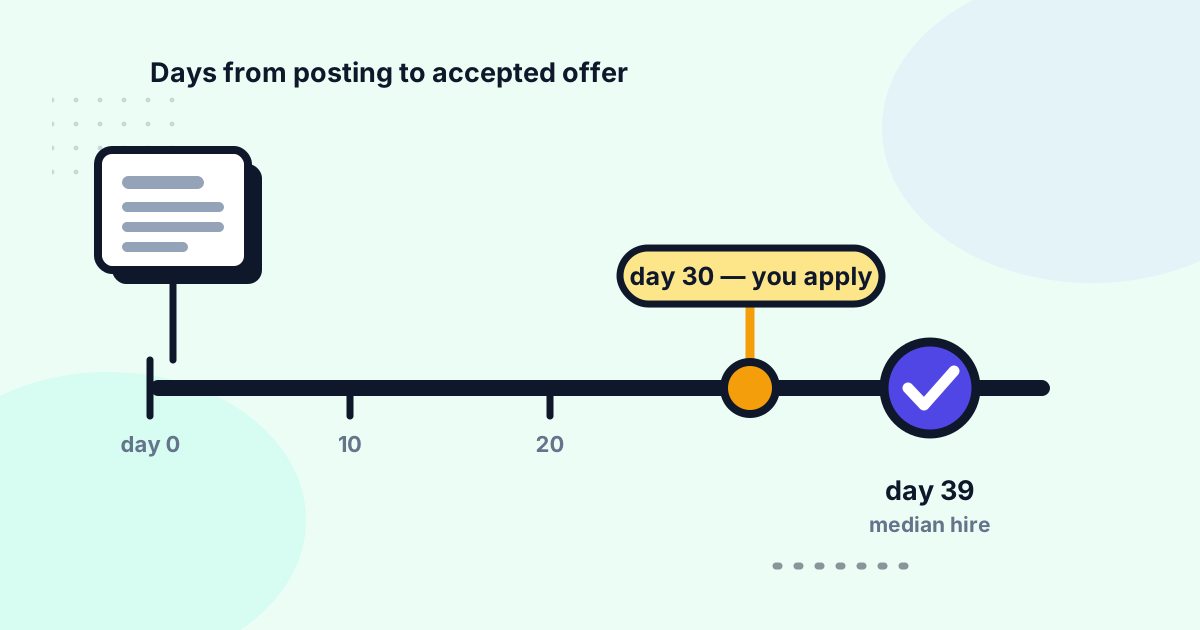
Yes. Apply. The median non-executive role takes 39 calendar days to fill — so a posting that went up 30 days ago is, on average, still nine days from an accepted offer.
“Too old to bother” usually means “still open, fewer people bothering.”
The 30-second version
- Median time to fill a non-executive role: 39 calendar days.
- A 30-day-old posting is typically mid-process, not closed.
- Application volume front-loads — most of the 244 applicants arrive in week one.
- Applying late means a thinner pile and a recruiter who’s still short of finalists.
- Check the company’s own careers page to confirm it’s live. That’s the real test, not the date.
The number that settles it
SHRM’s 2026 recruiting benchmarking, drawing on data from over 4,600 organizations, puts the median time-to-fill for non-executive positions at 39 calendar days.
Median, calendar days — weekends and holidays included. So half of all roles take longer than 39 days from requisition to accepted offer.
Why it matters: the posting date is not a countdown to a closed door. At day 30 the typical role is still in interviews, and roughly half of roles are nowhere near done.
Why late can genuinely be better
Application volume is heavily front-loaded. A posting draws its crowd in the first few days, when it’s fresh in the feed and the alerts fire.
Greenhouse’s March 2026 benchmark report has the average job pulling 244 applications, up 111% since 2022. The bulk of those land early. By day 30 the flow has slowed to a trickle — while the recruiter, if the role is still open, has a problem: they haven’t found the person yet.
That’s the good version of applying late. You arrive in a thinner pile, aimed at someone actively short of candidates.
The bad version is that the role is quietly filled and nobody took the posting down. Which is why you check.
How to tell if it’s actually live
- Look on the company’s own careers page. If it’s there, it’s almost certainly real. If it’s only on an aggregator, that’s a yellow flag — boards cache listings long after roles close.
- Check for a repost date. Many systems show “reposted” or an updated date; a recent one means active.
- Check the requisition ID if there is one. A role reposted under a new ID is usually a genuine restart.
- Look for the recruiter on LinkedIn. If they’ve posted about the role recently, it’s live.
- Just ask. A two-line message — “is the X role still open?” — costs nothing and often gets a straight answer.
Bottom line: the date on the listing tells you far less than which site it’s on.
When to skip it
- The posting is 90+ days old and appears nowhere on the company site.
- It’s on an aggregator only, with no requisition ID and no matching page anywhere.
- The company has since announced a hiring freeze or layoffs.
- You’ve applied to the same requisition already — reapplying to the identical ID doesn’t help.
FAQ
Is it too late to apply after two weeks? Not remotely. Two weeks in, most roles are barely through first-round screening.
Do recruiters look at applications in the order they arrive? Often, roughly — which is an argument for applying early when you can. But “reviewed in order” also means late applications get looked at when the early pile didn’t produce a hire.
Should I mention that I know the posting is old? No. Just apply normally. There’s nothing to explain — you’re responding to a listing that’s still up.
Bloom keeps one master resume and generates a tailored version per posting in a couple of minutes, checking every line against your source resume — so applying to a 30-day-old listing costs you minutes, not an evening. Try it free.
Sources
- SHRM, 2026 Recruiting Executives Benchmarking — median 39 calendar days to fill non-executive positions; data from 4,600+ organizations.
- Greenhouse, The Hire Standard: benchmark report, March 2026 (North America) — 244 applications per job in 2025, up 111% since 2022.