Job Boards vs. Company Career Sites: Where Hires Actually Come From
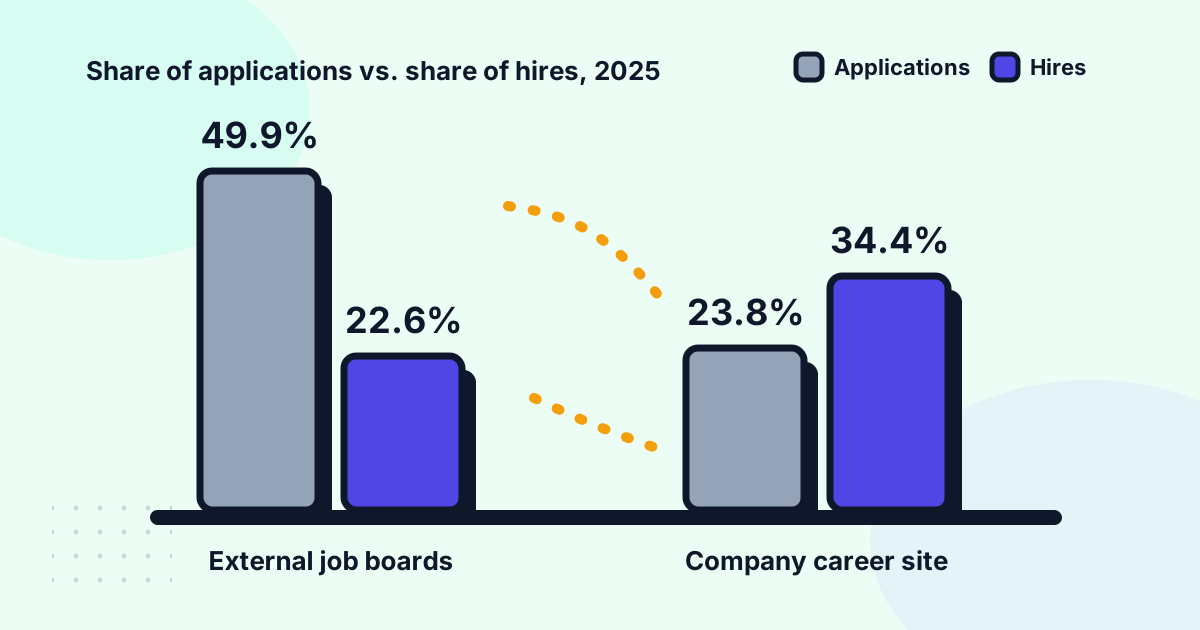
Apply on the company’s own site. External job boards generate about half of all applications and produce under a quarter of hires. Company career pages do almost exactly the reverse.
Same jobs. Same candidates. Different door.
There is no shortage of openings, either — the Bureau of Labor Statistics counted 7.3 million of them in July 2026, against 5.1 million hires that month. The bottleneck isn’t how many jobs exist. It’s which door your application walks through.
The 30-second version
- External job boards: 49.9% of applications → 22.6% of hires.
- Company career sites: 23.8% of applications → 34.4% of hires.
- That’s roughly a 3× difference in conversion per application.
- The one-click apply is the problem: it’s frictionless for you and for the other 243 people.
- Find the listing anywhere. Apply where the employer actually looks.
The numbers
Greenhouse analyzed more than 640 million applications across more than 6,000 companies over three years. Their March 2026 benchmark report breaks 2025 down by where the application came from and where the hire came from.
(Worth saying plainly: Greenhouse sells hiring software, and “company career pages work better” is a conclusion that suits them. We’re citing it anyway because the dataset is enormous and the mechanism below is independently sensible — but weigh it as a vendor report, not a neutral audit.)
| Source | Share of applications | Share of hires |
|---|---|---|
| External job boards | 49.9% | 22.6% |
| Company career site | 23.8% | 34.4% |
| Referrals | — | 11.6% |
| Recruiter-sourced | 2.9% | 9.7% |
Read the top two rows as ratios rather than percentages. External boards convert at roughly 0.45 hires per unit of application volume. Company sites convert at about 1.45. Applying through the company’s own page is worth something like three of the same application fired through an aggregator.
And it was worse before. Greenhouse notes external boards accounted for only 17% of hires in 2024 while generating nearly half of all applications — 2025 was an improvement.
Why the gap exists
Nothing mystical. Three boring mechanics.
One-click apply is frictionless in both directions. The same button that lets you apply in four seconds lets everyone else apply in four seconds. Volume goes up, signal goes down, and the pile gets triaged harder.
Aggregator listings go stale. Boards scrape and cache. A posting can sit live on an aggregator after the role is filled, closed or frozen. The company’s own page is the source of truth.
Fields get dropped in transit. Third-party applications arrive with whatever the integration passed through. Applying natively means the employer’s system gets the answers to its own screening questions, in its own format.
Why it matters: none of this means the boards are useless. They’re an excellent discovery surface. They’re just a worse submission surface.
What to actually do
- Find jobs anywhere. Boards, aggregators, LinkedIn, newsletters. Discovery is what they’re good at.
- Then go to the company’s careers page and search the title there before applying.
- Apply natively if the role is listed. Answer the screening questions properly — that’s the part the aggregator would have flattened.
- If it’s not on their site, treat it as a yellow flag. It may be filled, or it may never have been real.
- Referrals still beat everything. They’re 11.6% of hires from a tiny share of volume. One message to someone you actually know outperforms twenty cold applies.
Bottom line: the extra four minutes is the highest-leverage four minutes in your search.
Doesn’t applying twice hurt?
No. Applying through a board and the company site isn’t sabotage — most systems dedupe on email, and a recruiter seeing two records of the same person reads as enthusiasm, not error.
If you only do one, do the company site.
FAQ
Is LinkedIn Easy Apply bad? It’s fine for discovery and low-stakes volume. But it’s the purest version of the frictionless problem — treat an Easy Apply as a lottery ticket, and apply natively for anything you actually want.
What if the company site redirects to a job board? Then that is their system, and you’re applying natively. Plenty of employers run their careers page on Greenhouse, Workday or Lever — that’s the employer’s ATS, not an aggregator.
Should I stop using job boards? No. Half of all applications start there for a reason: it’s where the jobs are visible. Use them to find, not to send.
Bloom keeps one master resume and builds a tailored version per posting in a couple of minutes — and checks every line against your source resume, so the version you paste into the company’s own form still only claims things you actually did. Try it free.
Sources
- Greenhouse, The Hire Standard: benchmark report, March 2026 (North America) — application and hire source mix for 2025; 640M+ applications across 6,000+ companies.
- U.S. Bureau of Labor Statistics, Job Openings and Labor Turnover Summary, July 2026 — 7.3 million job openings, 5.1 million hires.