How to Prepare for an Interview: A Complete System (With the Tools to Run It)
Most interview prep advice is a pile of disconnected tips: research the company, practice common questions, dress well, send a thank-you note. All true, all useless without a system to hang them on. This is the system. Follow it and you’ll walk into your next interview genuinely prepared — not just hoping the questions are easy, but ready for the ones that aren’t.
The throughline of everything below is one principle: good interview prep is built on a foundation of real experience you can speak to honestly. Every technique here works better when your stories are true, and most of them fall apart when they’re not.
This version of the guide also shows the system running inside Bloom’s Interview Hub — the prep checklist, the round-specific cheat sheet, and the STAR story builder — so you can see what each step looks like when the setup work is done for you. Every screenshot below is a real prep session for a real (sample) resume. Use the tools or run it with a notebook; the system is the same.
Step 0: Get the logistics and the plan in one place
Prep dies in scattered tabs: the JD in one, your resume in another, a notes doc somewhere, the interview invite buried in email. The first move is consolidation — one place that knows which job, which round, what date, and what’s left to do.
This is what the Interview Hub’s overview gives you the moment you pick a job from your tracker: a readiness checklist (it checks off automatically what you’ve already done in Bloom, like tailoring your resume to this JD), your interview schedule by round type, and the one-click entry into the prep materials for that specific round.
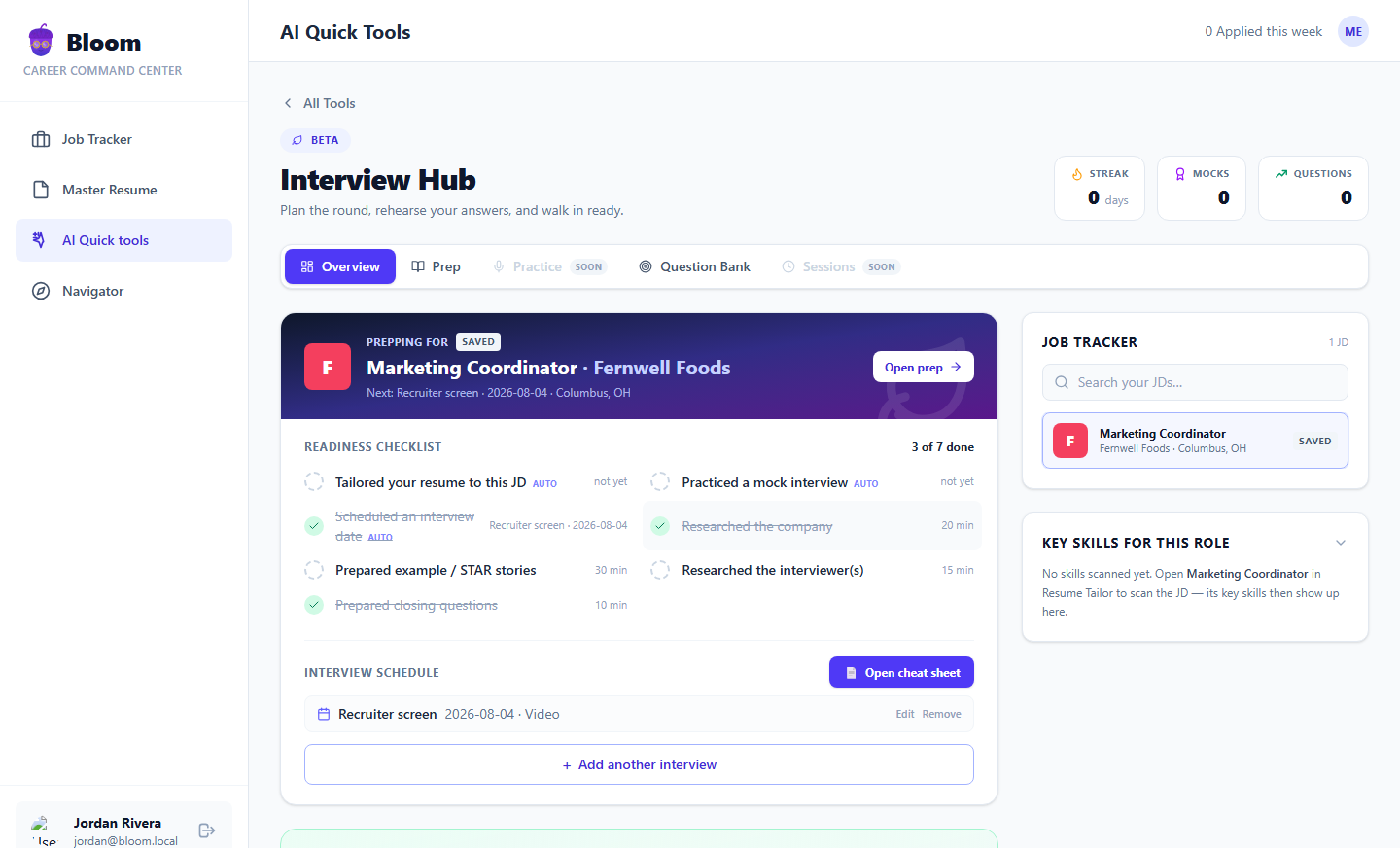
Notice the schedule is round-typed — a recruiter screen is a different conversation than a technical round or a panel, and your prep should know which one is coming. That distinction drives everything the cheat sheet generates.
Step 1: Start with your own resume
Before you research anything external, study the document the interviewer will be holding: your resume. Interviewers build most of their questions directly off it — they scan it and ask you to expand on whatever stands out.
So your first prep move is to read your resume as an interviewer would and identify the three to five bullets most likely to draw a “tell me more about this.” Those are your high-probability questions.
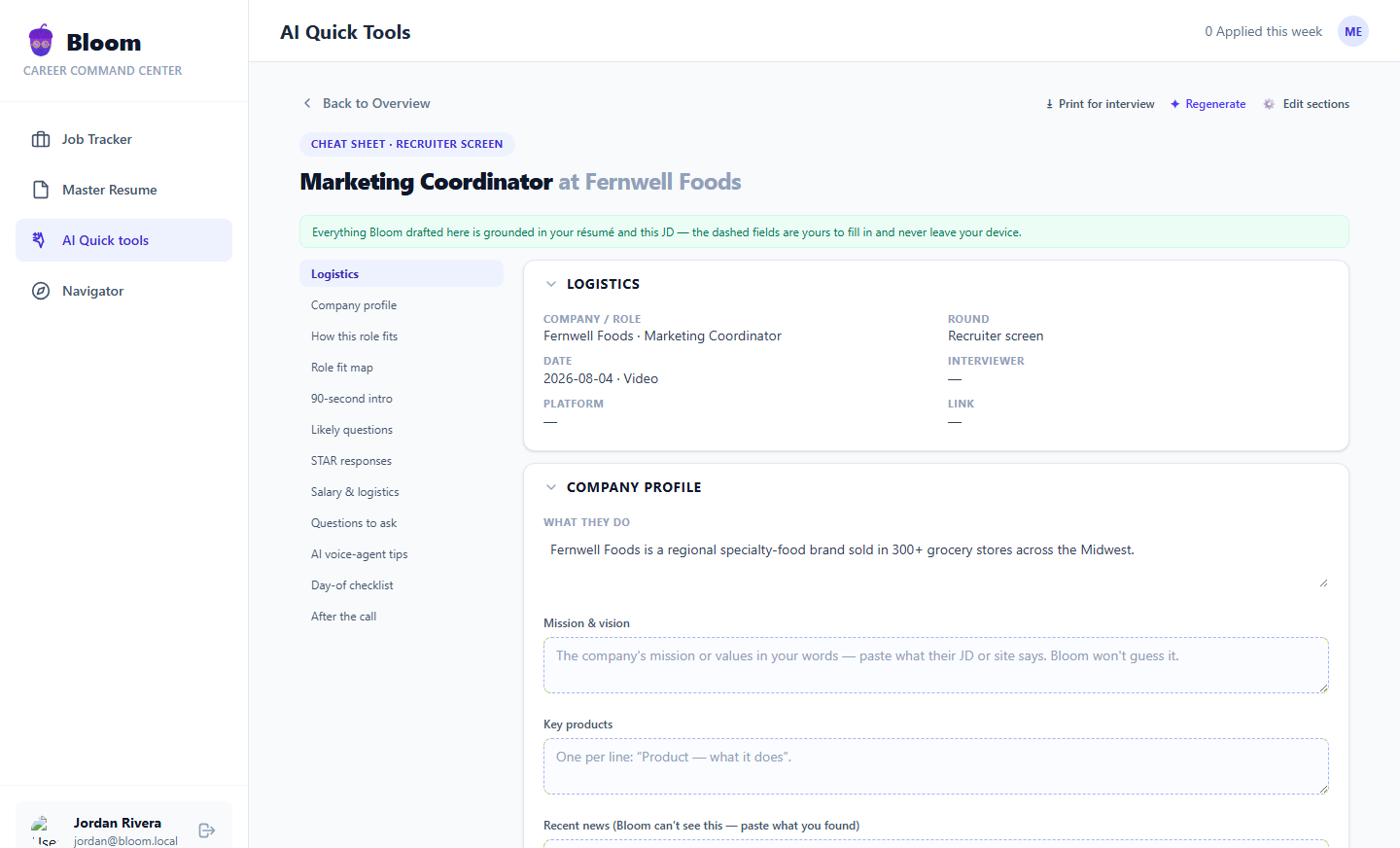
This is exactly what the cheat sheet automates. When Bloom drafts one, it reads your resume and the job description together and predicts the likely questions for this round — then drafts a first-pass answer for each using only what your resume actually says. The banner at the top of every sheet is the contract: everything drafted is grounded in your résumé and this JD.
Here’s what that looks like in practice. These are generated likely-questions for a recruiter screen — and every fact in the draft answers (the 12,000-subscriber email list, the 24%→31% open-rate lift, the campaign tracker the team kept using) comes straight from the sample resume’s bullets. Nothing is invented, which means every draft answer is one the candidate can actually stand behind and expand on:
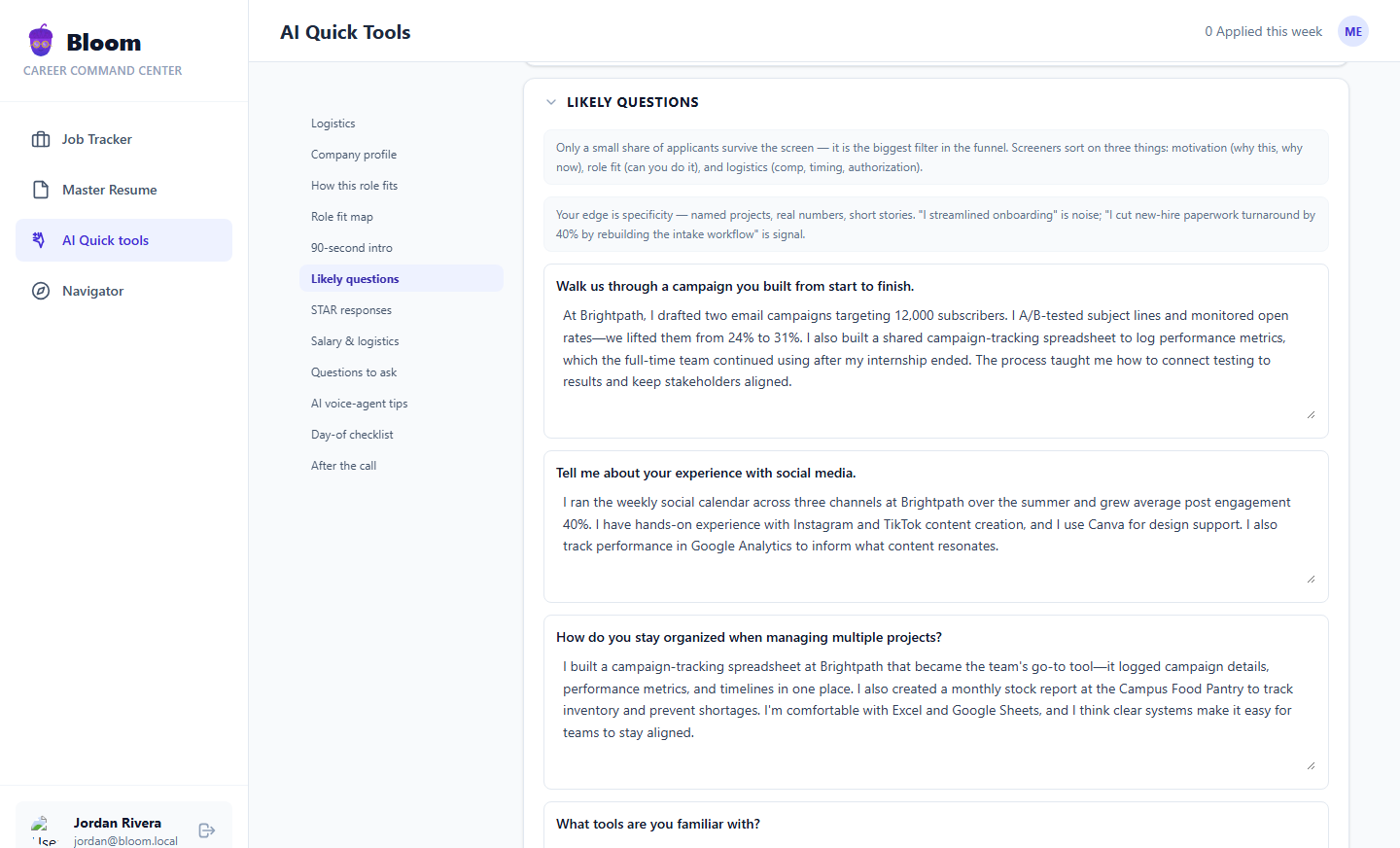
Treat drafts like these as your starting outline, not a script: read them, adjust the phrasing to how you actually talk, and then practice them out loud (Step 5).
Step 2: Build STAR stories for your key bullets
For each bullet you circled, prepare a STAR story:
- Situation — the context. Where were you, what was going on?
- Task — what needed to be done, what was your responsibility?
- Action — what you specifically did (not “we” — you).
- Result — what happened, ideally with a real, specific outcome.
STAR isn’t a script to memorize word-for-word — that reads as robotic. It’s a structure to make sure your story has all four parts, so you don’t ramble into a great Situation and forget to land the Result.
Here’s the key: because your bullets are real, your STAR stories are real. You’re not inventing anything. You’re taking something you genuinely did and making sure you can tell it in a clear, complete arc under pressure.
The cheat sheet’s STAR builder runs this step the honest way: you tell the story in your own words, like you’d tell a friend, and Bloom sorts your own sentences into Situation / Task / Action / Result — it never adds anything you didn’t say. Here’s the campus-food-pantry story from this guide, told freeform and structured:
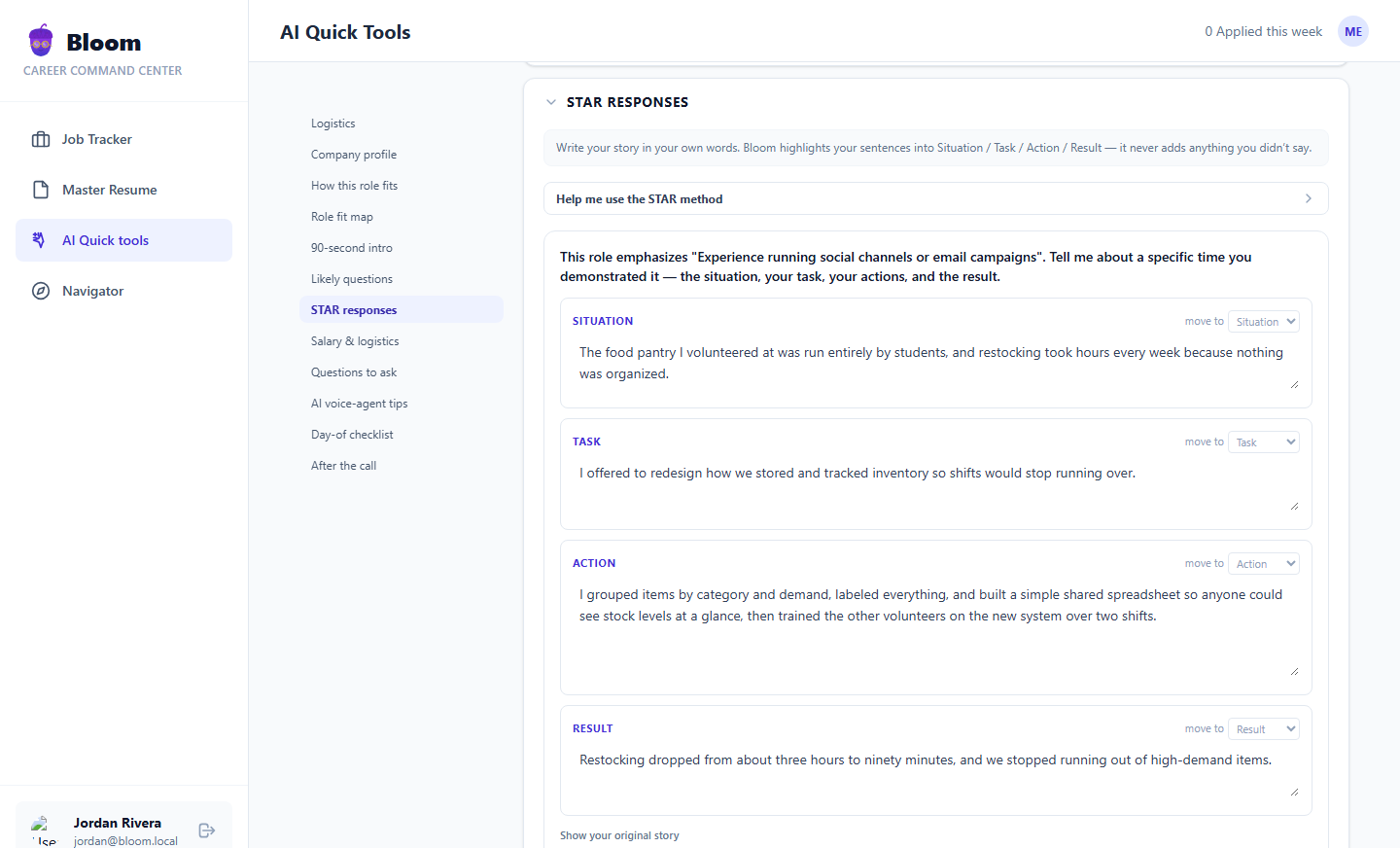
Every word is true, so under questioning — “how did you decide the categories?”, “what pushback did you get?” — you have real answers, because you really did it. That’s the whole point of grounding prep in genuine experience.
Step 3: Prepare to defend, not just describe
Describing what you did is the easy half. Interviewers probe. So for each STAR story, anticipate the follow-ups:
- “Why did you do it that way?” — Be ready to explain your reasoning, not just your actions.
- “What would you do differently?” — Shows reflection. Have a genuine answer; “nothing” reads as no self-awareness.
- “What went wrong?” — Almost everything real has a wrinkle. A candidate who can discuss a setback honestly is far more credible than one whose every story is flawless.
- “What was your specific role?” — Especially for team projects. Be honest and precise about what was yours versus the group’s.
This is where grounded experience becomes a genuine advantage. A candidate telling a true story can go arbitrarily deep — every follow-up has an answer because the memory is real. A candidate who embellished hits a wall the moment the questions go past the rehearsed surface. You cannot prep your way out of a fabricated story; the follow-ups will always eventually find the edge of what you invented. It’s the same reason Bloom verifies every tailored resume bullet against your real experience before you ever send it: the resume you hand over is the set of claims you’ll be defending in this room.
Step 4: Practice the common questions — in your own words
Beyond your resume-specific questions, prepare for the standards:
- “Tell me about yourself.” — A 60–90 second arc: who you are, relevant experience, why you’re here. Not your life story. (The cheat sheet drafts this as a “90-second intro” grounded in your resume — again, a starting outline to make your own.)
- “Why this company / role?” — Requires real research. Generic answers are obvious and deadly. Note what the cheat sheet does here: the company-profile fields for mission, products, and recent news are deliberately left for you to fill in — Bloom won’t guess at facts about the company it can’t see, and honestly, doing that research yourself is part of the prep.
- “What’s your greatest weakness?” — Name a real one and what you’re doing about it. Avoid the fake-humble “I work too hard.”
- “Tell me about a time you failed / faced conflict / led something.” — These are STAR-story prompts. You likely already have stories from Step 2 that fit.
Write bullet-point notes, never full scripts. You want to internalize the substance so you can speak naturally, not recite. Memorized answers die the moment the interviewer phrases the question slightly differently.
Step 5: Practice out loud (this is the step everyone skips)
Reading your prep silently feels productive and barely helps. The gap between “I know what I’d say” and “I can actually say it smoothly under pressure” is enormous, and you only close it by speaking.
- Say your STAR stories out loud, ideally to another person. Hear where you ramble or blank.
- Do a mock interview with a friend, a career center counselor, or even your phone’s voice recorder. Play it back — you’ll catch filler words, run-ons, and weak endings.
- Practice the awkward pause. When asked something you didn’t prep, the skill is taking a calm two-second beat to think, instead of panicking.
Saying your real stories aloud a few times is the single highest-return prep activity. It turns true experiences into fluent answers.
Step 6: Prepare your own questions
Interviews end with “What questions do you have for us?” — and “none” is a near-disqualifying answer. Having sharp, role-specific questions ready signals genuine interest and turns the interview into a two-way conversation.
The cheat sheet drafts these from the job description itself — questions about this team, this role, this process, not generic ones you could ask anywhere. For the sample Marketing Coordinator role, it proposed asking how seasonal launches affect the content calendar and what metrics the marketing lead actually reviews — both lifted from responsibilities in the posting:
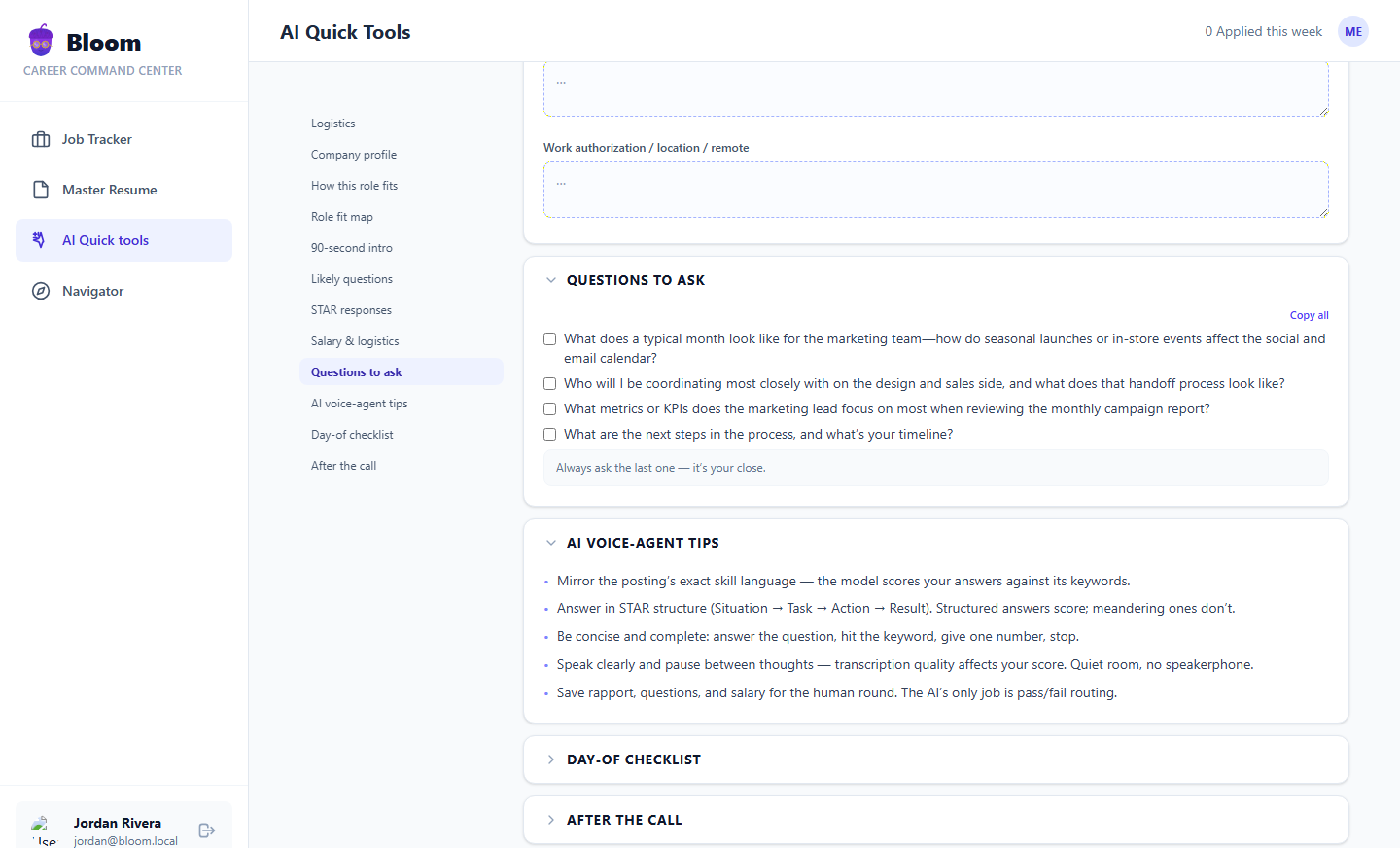
Whatever you use, prepare three or four, and save the next-steps question for last — it’s your close.
Step 7: Handle the logistics so they don’t rattle you
Prep isn’t only content. Reduce day-of friction:
- Confirm the details — time, location or video link, who you’re meeting, format (panel? technical? case?).
- Test your tech for virtual interviews — camera, mic, connection, a clean background.
- Plan to arrive early — 10 minutes for in-person, 5 minutes logged on for virtual.
- Bring/have ready — copies of your resume, a notepad, the questions you prepared.
The cheat sheet keeps all of this in its logistics block and a day-of checklist, and the whole sheet prints to a single page you can review in the lobby. These details don’t impress anyone, but fumbling them adds stress that bleeds into your answers.
A prep checklist
- One place holding the JD, your resume, the schedule, and your prep (a hub or a folder — just not six tabs)
- Read your resume; circle the 3–5 likely-question bullets
- Build a STAR story for each, all grounded in real experience
- Prepare follow-up answers (why, what went wrong, what you’d change)
- Bullet-point notes for the common questions, in your own words
- Research the company yourself — mission, products, recent news
- Practice everything out loud, ideally in a mock interview
- Prepare 3–4 role-specific questions to ask them, next-steps question last
- Confirm logistics and test any tech
The bottom line
Interview prep isn’t about memorizing perfect answers or gaming the process. It’s about taking the real experience you already have, structuring it so you can tell it clearly, and practicing until it’s fluent under pressure. Every step of this system rests on that foundation — which is exactly why a grounded, defendable resume and honest stories make prep dramatically easier, and why the tooling that helps most is the kind that organizes and structures what’s true instead of inventing what isn’t. There’s nothing to hide, nothing to keep straight, no wall waiting three follow-ups deep. You just walk in, tell the truth well, and let the real work you’ve done speak. That’s a candidate who’s genuinely ready.
Bloom’s Interview Hub turns this system into a checklist, a round-specific cheat sheet, and a STAR story builder — all grounded in your real resume, never invented. Resumes you can defend. Try Bloom free →