How Many Jobs Should You Actually Apply To?
Ten to fifteen a week, done properly, beats fifty fired off blind. Not because effort is virtuous — because the math changed.
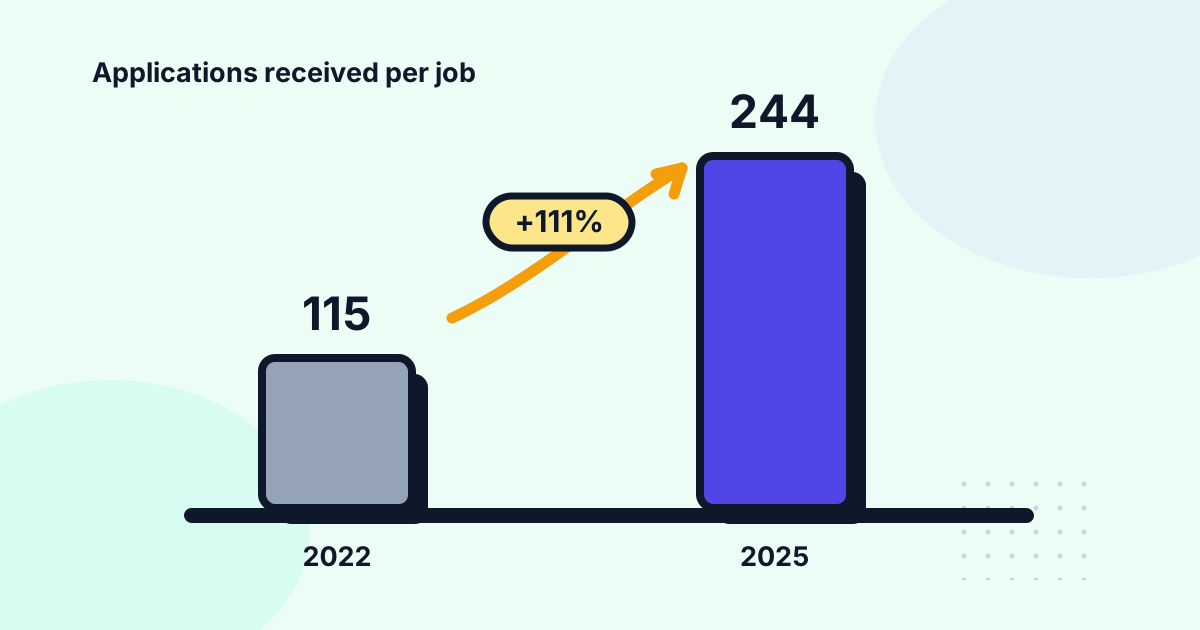
The average job now draws 244 applications. You are not going to win that by adding a 245th identical one.
The 30-second version
- Applications per job went from about 115 in 2022 to 244 in 2025 — up 111%.
- Volume used to work. At 244-deep piles, it’s the losing move.
- Target 10–15 real applications a week, not 50 blind ones.
- Spend the saved time on channel (apply on the company site) and fit (tailor the top third).
- Track them. You cannot run a funnel you can’t see.
The math that broke the old advice
“Apply to everything” was reasonable advice in a thinner pile. It isn’t now.
Greenhouse’s March 2026 benchmark report — built on more than 640 million applications across more than 6,000 companies — found the ratio of applications per job rose 111%, from roughly 115 per role in 2022 to 244 in 2025.
Why it matters: if you’re candidate 244 and you look like candidates 1 through 243, nothing about your application is doing work. Doubling your output doubles your share of a pile that is being triaged harder every year.
The lever moved from how many to which, and how.
So what’s the right number?
There isn’t a universal one, but there is a usable frame: applications you can defend, per week.
- 10–15/week if you’re searching actively and have time. Roughly two or three a day, each with a real look at the posting.
- 4–6/week if you’re employed and doing this around a job. Fewer, sharper, aimed at roles you’d actually take.
- 20+/week only if you’re using a genuinely repeatable system — one master resume, fast per-role tailoring, and a tracker. Otherwise you’re manufacturing rejections.
The test for whether your number is right isn’t the count. It’s whether you could open any application from last week and explain, in one sentence, why you’re a fit for that posting.
If you can’t, the number is too high.
Where the saved time should go
Cutting from 50 to 15 buys you back hours. Two places to spend them:
Channel. The same Greenhouse dataset shows external job boards produce 49.9% of applications but only 22.6% of hires, while company career sites produce 23.8% of applications and 34.4% of hires. Applying on the employer’s own page is worth roughly three of the same application through an aggregator. That’s a four-minute change per application.
The top third. Nobody reads your whole resume in a 244-deep pile. Re-order the top third so the first eight seconds land on what this posting asked for. You’re not rewriting; you’re re-emphasising.
Bottom line: 15 applications through the right door with a tailored top third will out-perform 50 Easy Applies, and take less total time.
Track them or you’re guessing
A spreadsheet is fine. What matters is that you can answer: how many did I send, through which channel, how many replied, and how long did they take?
Without that you can’t tell a bad resume from a bad channel from a bad target list — and those three problems have completely different fixes.
FAQ
Is it bad to apply to a lot of jobs? Not inherently. It’s bad to apply to a lot of jobs identically. If you’ve genuinely got a repeatable system, high volume is fine. Most “high volume” is actually low effort with extra steps.
How many applications does it take to get a job? There’s no honest single number — it swings wildly by field, level and market. Which is exactly why the useful metric is your own reply rate, tracked over time, rather than someone else’s average.
Should I apply to jobs I’m not fully qualified for? Yes, within reason. If you hit most of the core requirements, apply. The listed “requirements” are usually a wish list. Just don’t let “stretch role” become “unrelated role” — that’s how the 50-a-week trap starts.
Bloom keeps one master resume and generates a tailored version per posting in a couple of minutes, then verifies every line against your source resume — which is what makes 15 properly-aimed applications a week actually sustainable. Try it free.
Sources
- Greenhouse, The Hire Standard: benchmark report, March 2026 (North America) — applications per job 2022–2025; application and hire source mix; 640M+ applications across 6,000+ companies.
- U.S. Bureau of Labor Statistics, Job Openings and Labor Turnover Summary, July 2026 — 7.3 million openings against 5.1 million monthly hires.