Recruiters Are Using AI to Filter You Out. You're Using AI to Beat the Filter. Nobody's Checking Who's Right.
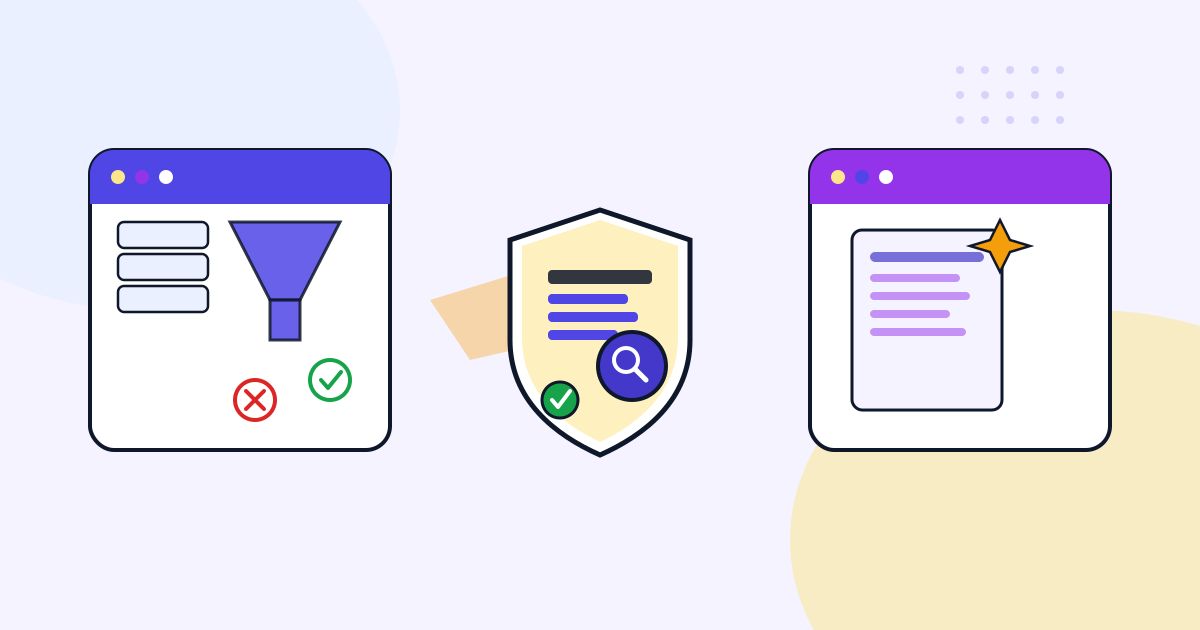
You’re not imagining it. The job search got harder because both sides quietly automated at the same time. Recruiters now use AI to filter resumes faster than ever, you’re using AI to write resumes fast enough to survive that filter, and — here’s the part nobody’s advertising — there is no referee. Two machines are grading each other’s homework, and the only verification actually happening is whichever side built one in on purpose.
That’s not a metaphor. It’s the literal mechanism behind “why do I never hear back,” and it has a fix that isn’t “try harder” or “write a better cover letter.” It’s a specific technical step most tools skip. More on that below — first, the arms race itself.
The recruiter side sped up first 🏃
The numbers: 58% of hiring managers now use AI to screen resumes and applications, up from 35% in 2025, according to Resume Genius’s 2026 Hiring Trends Report. That’s not a niche tool adoption curve — that’s a majority flip in a single year. Zoom out further and 87% of hiring managers say their company has implemented AI somewhere in the recruitment process, up from 82% in 2025, per the same report.
Translation: the assumption that “a human reads every resume” was already shaky. Now it’s closer to “an algorithm reads every resume, and a human reads whatever survives.”
The candidate side caught up fast
You didn’t invent the response to that — you just noticed the same thing everyone else did. 59% of job seekers say they use AI for writing resumes, and 78% are open to using AI somewhere in their job search, according to Resume Genius’s 2026 Job Seeker Insights Report.
Yes, but: this is where “arms race” stops being a headline word and starts being an accurate description. You’ve got a filter tuned to catch certain patterns, and a generator tuned to produce whatever gets past that filter, running against each other at scale, with millions of resumes as the training ground. Neither side is static. Both sides adjust. Nobody’s declaring a winner because there isn’t one — there’s just an escalating loop.
Everyone agrees the loop is broken. Nobody trusts either half of it
This is the part that should actually worry you, and it’s not a vibe — it’s measured. 63% of candidates have now been interviewed by an AI, up 13 percentage points in six months, but only 21% of U.S. candidates believe most employers are using AI responsibly and transparently, per Greenhouse’s 2026 Candidate AI Interview Report. 38% of candidates have already walked away from a hiring process specifically because it included an AI interview, and another 12% say they would.
Zoom out: this distrust isn’t a 2026 mood swing — it’s a multi-year baseline. Back in 2023, Pew Research found 71% of Americans opposed letting AI make final hiring decisions outright, versus just 7% in favor. That gap hasn’t closed; it’s arguably widened as both sides leaned in harder.
And it’s not just candidates who are uneasy. Even the people running these systems aren’t fully sold. Confidence in AI hiring tools among HR leaders and employees only grew from 37% to 51% between 2024 and 2025, according to HireVue’s 2025 AI Report — a coin flip, from the people whose job it is to trust the tool.
So: recruiter AI is unaudited from where you sit. Your AI is unaudited from where the recruiter sits. And the people operating the recruiter side are only about 50/50 on trusting their own system. That’s the whole doom loop in one paragraph.
So who actually checks either side? 🔍
Here’s the mechanism piece, because “nobody’s checking” isn’t quite true — it’s that almost nobody’s checking the part that matters to you.
The recruiter’s AI is checking for pattern-match: does this resume’s language look like the job description’s language. That’s the entire job of an ATS filter, and it’s exactly why AI resume tools got popular in the first place — you can read how those match scores actually work if you want the mechanics.
Your AI, left unchecked, is optimizing for the same thing from the other direction: make the language match harder. And an AI optimizing purely for “sound like a stronger match” has a well-documented failure mode — it invents things. A tool a certification you don’t have, a platform you never touched, upgrades “assisted with” to “led.” We’ve written before about how often this actually happens, and it’s not rare.
Nobody in that loop is checking whether what your AI generated is true. The recruiter’s filter doesn’t care — it’s matching keywords, not verifying your work history. Your AI doesn’t check itself — it’s optimizing for match score, not accuracy. That’s the actual gap. Not “AI vs AI is unfair,” but “there is a specific, checkable step — is every claim on this resume grounded in something you actually did — that neither side’s system performs.”
That’s the step that closes the loop. Concretely: after AI tailors a bullet to a job description, a second, separate pass has to go line by line and check each claim against your original resume — did you actually list this tool, this title, this certification, this scope of ownership — before you ever hit send. Not a vibe check. A per-bullet comparison against your own source material, flagging anything invented so you can fix it before a human — or another algorithm — ever sees it.
This is the whole reason Bloom builds tailoring and verification as two separate steps instead of one. Bloom verifies every tailored bullet against your source resume before you send it, so the fabrication risk that comes standard with “AI writes your resume fast” gets caught on your side of the fence, not discovered by a recruiter later. It doesn’t fix the recruiter’s filter. But it means the AI working for you isn’t quietly making the same trust problem worse. If you’re wondering whether tailoring is even worth the effort in the first place, that’s a fair separate question — the honest answer is it works if what it produces is still true.
Bottom line
The arms race is real, it’s measured, and it’s not going to referee itself — recruiters aren’t going to slow down their AI adoption, and you’re not going to stop using yours. The only lever you actually control is making sure your side of the exchange is accurate. A resume that’s fast to produce and fabricated is worse than the problem it was solving. A resume that’s fast to produce and verified against your own history is the only version of “AI vs AI” that ends in your favor.
FAQ
Q: Is the “AI vs AI” hiring arms race a real, measurable thing, or just a trend piece? It’s measurable on both sides. Recruiter-side AI screening jumped to 58% adoption in 2026 from 35% in 2025, and 59% of job seekers report using AI to write resumes — two large, independent survey findings pointing at the same escalation, per Resume Genius’s hiring report and job seeker report.
Q: Why do I never hear back after applying, even to jobs I’m qualified for? Part of it is volume — AI tools make it cheap to apply to more jobs, so more resumes hit the same filters. Part of it is that the filter and your materials may simply not be optimized against each other. And if AI helped write your resume, an unverified claim or awkward keyword-stuffing pattern can also work against you rather than for you.
Q: Does using AI on my resume make me less trustworthy to recruiters? Not inherently — most job seekers now use AI somewhere in the process, per the same Resume Genius data. What erodes trust is AI-generated content that isn’t checked, especially fabricated details. Using AI honestly means using it to phrase and tailor, not to invent.
Q: Do recruiters actually trust their own AI hiring tools? Only about half do. HireVue’s 2025 AI Report found HR leader and employee confidence in AI hiring systems at 51% in 2025, up from 37% in 2024 — better, but still close to a coin flip.
Q: What can I actually control in a hiring process I don’t trust? The accuracy of your own materials. You can’t audit a recruiter’s ATS, but you can make sure anything AI helped you write is checked line by line against what you actually did before you send it — which is the one part of this loop that’s fully within your control.
Ready to tailor a resume without gambling on what your AI made up? Try Bloom and see every bullet checked against your source resume before it goes anywhere.